
The lead-up
During the Dutch summer, the focus of most freedivers shifts from pool to depth, from chlorine-filled swimming pools to our beloved murky and dark lakes/quarries. It was also the summer of 2025 when I followed the ShareEQ course by Federico Mana, guided by The Dry Sessions, with a fellow freediving instructor as my peer. This course was mainly dry, working with the balloon and bubbler, but it complemented my RV training with MT Solomons philosophy and knowledge perfectly well.
Over the months, my EQ and depth adaptation both made big jumps. I knew I had the breath-hold to go deeper, so I wanted a test moment at the end of the season. What better than a competition to test things?
Why I thought a competition was a suitable setting:
I like to have a goal to train towards. What better than a place and time set to the exact day and minute.
Meet new freedivers. It’s always fun to meet other freedivers, and the international community is extra interesting.
Test my ability with some added competition stress. Even in a comp, everything should still work.
The best safety standards you could wish for.
Meet and talk to more experienced competitive freedivers. Soak up their knowledge.
Deciding which competition and setting the goal
For me, it started with the “when.” I knew which period would work for me, considering office work and my private situation. As for the “where”: currently, my budget is a bit tighter, so very exotic places were not an option. Europe or Egypt became my search area.
Tenerife / Atlantic Cup quickly became one of the top picks. Germany was also an option, but it was a bit too soon, too cold, and there would be less sun. Easy choice!
The main goal for the comp was the experience, but I also had a number in mind. Being a comfortable 40-meter diver, I still only have a few dives past 40 meters and a PB of 47 in free immersion. The (performance) goal for this comp: 50 meters in my favorite discipline, free immersion (FIM).
Local training and game plan
I picked a local comp (a self-proclaimed family comp). Not too many participants, affordable, and as we say in Dutch: gezellig! I arrived at the center a week before “day 1” to follow a safety course, to train, and to acclimatize and relax a bit. This turned out to be a great choice. It allowed me to get acquainted with the dive center, the people, and the water.
It was only during local training that I first switched to depth. The whole summer I hadn’t gone deeper than around 30 meters. I focused on residual volume (RV) dives to a max of 16 m, functional residual capacity (FRC) dives with mouthfill at the surface (max 28 m), and some 30-ish dives while testing the noseclip combined with the hektometer goggle. I was also still getting used to diving without warm-ups. So in all fairness, switching to more depth was quite the mental hurdle.
I had 3 training days and 2 competition days to reach my goal. Go time!
The first training session started on a buoy in front of the shore. A few RV dives to settle in, and I ended the session with a dive to 30 m as a “feeler.” It felt good!
Between the first and second training day, I did a 2-day safety course. I don’t count these two days as training for the comp, but the 30-meter rescue was definitely good CO₂ exposure!
After three days in the water, it was time for a rest day. I didn’t stay dry, though… I did some shallow dives to check out the wreck El Peñón in front of the coast of Tabaiba.
Training day 2:
A quick 10 m EQ check (aka a warm-up haha!) followed by a 41 m dive. After a longer break, I did a 44 m dive on the competition setup. Both dives were smooth, done with a lot of awareness, and they really boosted my confidence for the next day. One nice thing about the main line is that there is way more weight at the bottom, so you can get away with harder pulls. For me, this is helpful because I’m normally a bit slow in the early stage of a FIM dive.
Training day 3:
I started with a no-warm-up dive to 45 m on the buoy, or at least, that was the plan. I turned early because of two mistakes:
My noseclip wasn’t tight enough. I noticed air leaking after 2 meters, so I had to readjust the clip.
Might be related to the leaking noseclip, I was pulling the line too aggressively (catch up on lost time?). This caused slack in the rope between me and the surface, giving extra resistance on the lanyard’s carabiner. This made me look toward the surface to check if my floating noodle was not coming along.
These were mistakes that could easily have been avoided. Not huge ones, but they added some tension early in the dive. That tension grew instead of fading, and I decided to turn at 40 meters.
A bit bummed out, I decided to repeat the dive after a 10-minute break. On the second try, everything was good: gentler pulls and a super-tight noseclip. Since I still felt energized, I decided to try my goal on the competition setup. A clean dive with clear phases and a solid plan behind it. A new PB of 50 meters in FIM!
After the dive, I had a nice lunch with my girlfriend and a few other athletes. Back at the apartment, I had a call with my coach, MT. We discussed the dive, the sensations, and the plan for the competition. We decided that two rest days would bring more benefit than squeezing in another training day. Then start the competition conservatively with a 48 m dive. For me, it didn’t feel that conservative since it would still be my second-deepest dive ever, but let’s go!
Competition Day 1 – TAXI!!!!
On comp day, most of the athletes have their schedule for the day planned out. Mine looked like this:
10:05 — at dive center
10:15 — toilet and put on wetsuit
10:30 — walk toward taxi boat
10:40 — on taxi boat
10:45 — at dive spot
10:55 — EQ check to 10 meters – no hang.
11:20 — Official Top
All went according to plan until the taxi ride. Let’s just say we all severely underestimated how long the taxi boat would take to reach the diving spot. I arrived about 15 minutes later than expected. I had reserved some spare time, but it still wasn’t enough. Lesson learned: build in even more extra time for the parts that are out of your control.
I have to admit, I still wasn’t fully adapted to the no-warmup approach. The failed no-warmup dive of the last training day was still in my mind. So even though time was short and I felt a bit rushed, I still wanted to do my mini-warmup. For confidence, I felt I “needed” my 10 m EQ check. This is just an excuse, because my EQ had been flawless for months. What I really needed was comfort: to get in touch with the water, feel my body submerged, settle in. No hangs, not deep. Just feeling.
Soon after the warm-up, I moved to the competition line. Remember I said this was a family comp? Well, my newfound brother gave me a ride from the warm-up buoy to the comp line. Super nice, because even a 20-meter swim raises the heart rate. Love you guys!
As I moved to the line, the official competition dive watch was attached to my wrist and the tension started rising. I tried to keep it under control by checking in with my breath and using positive self-talk. The dive went smoothly, with good form and solid relaxation. Super happy that my very first depth competition dive was a white card!
Competition Day 2 – Cancellation?!
Now that all the protocols and logistics were known, and with a successful 48 and 50 meters in the pocket, I wanted to set a new PB on Day 2, so I announced 52 meters. There might be something going on with even numbers… OCD much, haha.
I had a similar plan to Day 1 and accounted for a bit more time for the boat ride. But when we arrived at the dive center, the greetings were quickly followed by the message that the comp was delayed by at least 15 minutes because of strong current. The next update, 10 minutes later, was that the competition day might be canceled altogether.
This felt like such a bummer. I immediately thought it was a shame I didn’t announce 52 on the first day. I tried not to let the negative thoughts take over. It wasn’t final yet, and Day 1 had still been a success. This was out of my control. After about an hour of waiting, the organization announced that the current was mostly gone and the competition could continue with a 75-minute delay. We’re on!!!
Okay, time to get the mind back to the dive. Back to the plan and make sure I was on the boat on time. Since the whole setup was familiar now, I was much more in the zone. Stress was lower, and I was actually looking forward to the dive. The mindset was repaired.
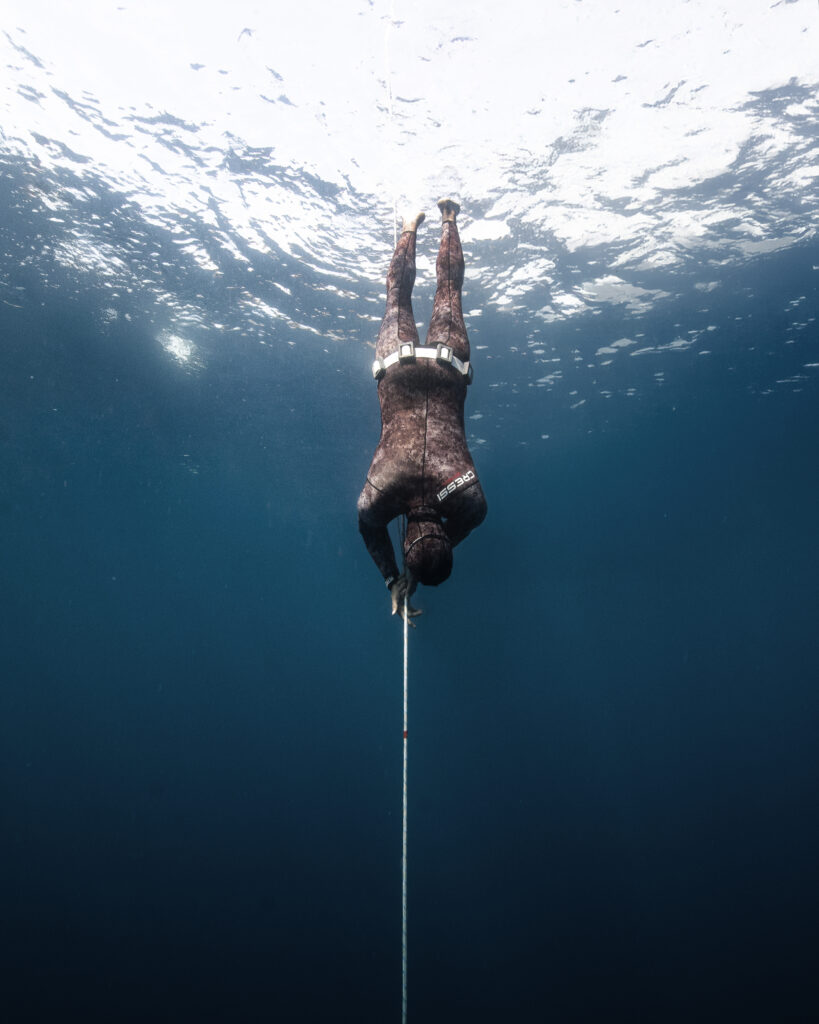
The water was a bit choppier compared to Day 1, but I wasn’t fazed. Breath-up and final breath were solid. I mis-grabbed the line once in the first few meters, but other than that things were going well until I had this weird swallowing sensation right after taking the mouthfill. The sensation kept increasing and I just had to swallow. Poof: air gone. I managed to get some air back into my cheeks, but my relaxation was totally gone. I aborted the dive around 40 meters, and the ascent wasn’t the easiest.
Coming to the surface, I made some jokes, but I was honestly quite bummed. I didn’t really care about the yellow card; I was mainly frustrated by that weird swallow sensation. This had never happened to me before…
After the comp, I had two lengthy calls with my coach—insights that are a bit too much for this blog. In short: I learned a lot, I can be proud, and I need more specific training to address a few issues.
In hindsight
My focus on EQ and RV was spot on for the months before the comp. Technically and physically, I was ready for 60 meters. What I lacked was a bit of mental readiness. In the future, I want a few solid weeks of depth-focused training, repeating 45–50 meter dives until they feel automatic before pushing deeper.
And yes, I’d absolutely like to do another competition!